WELLNESS
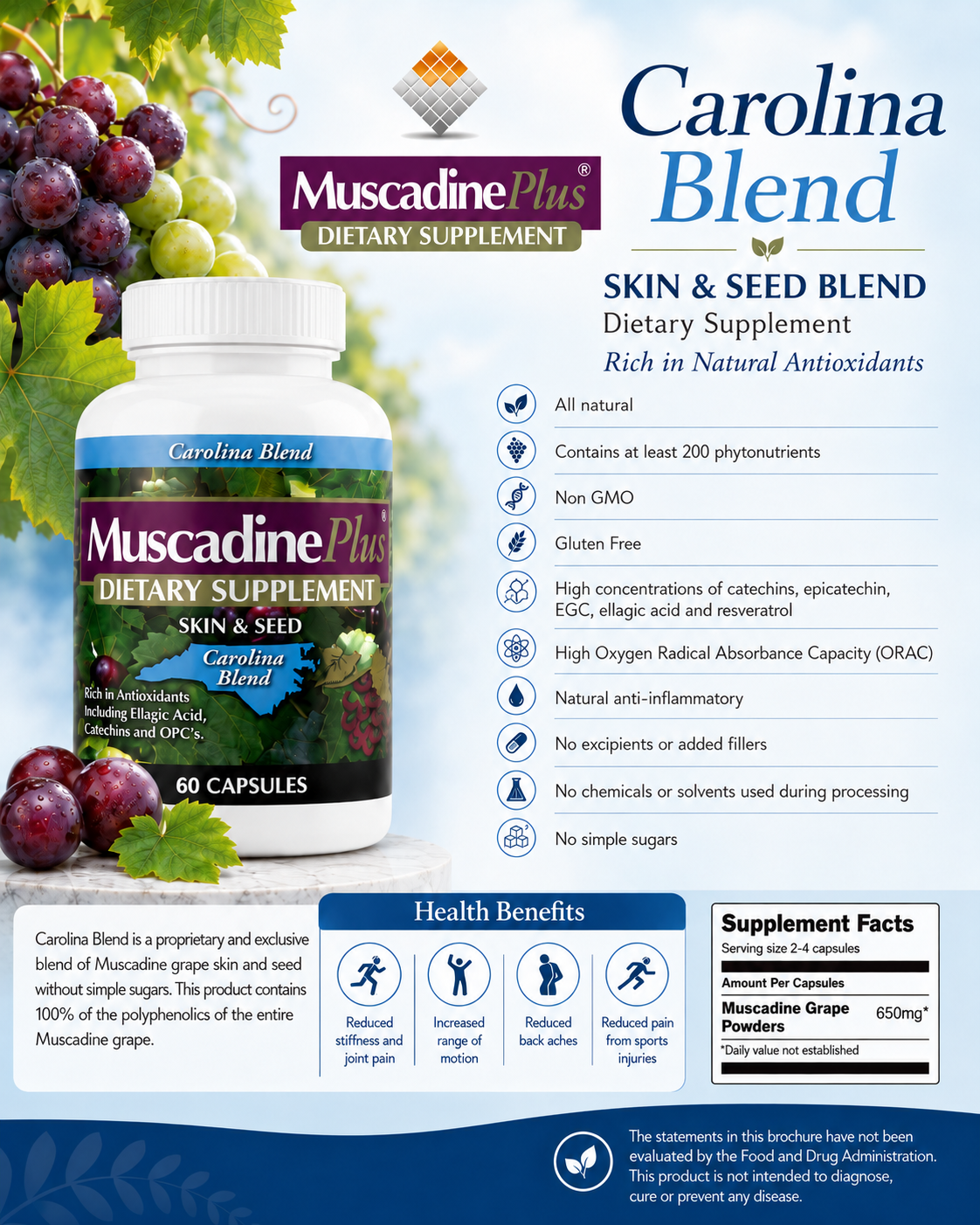
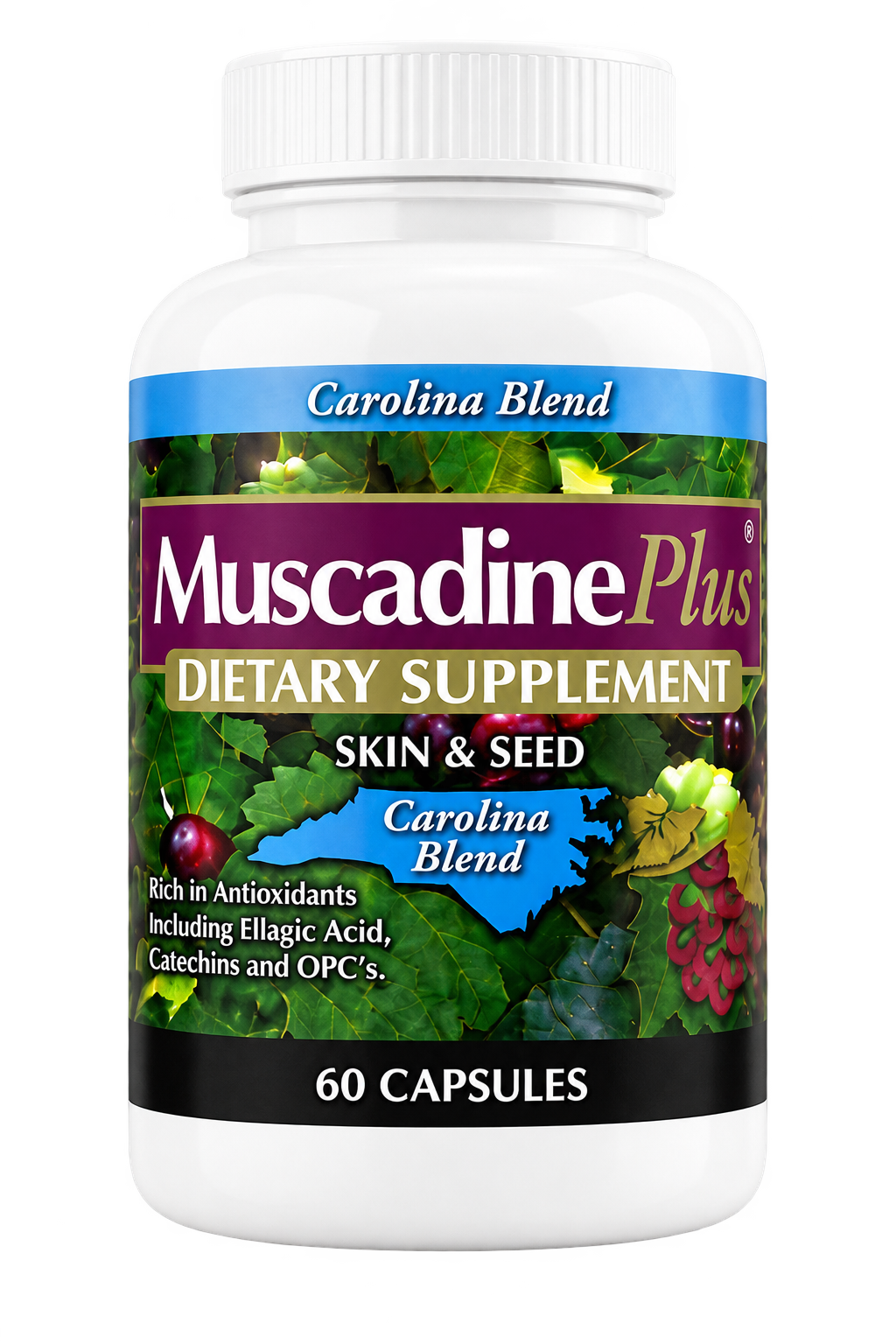
Muscadine Plus Carolina Blend
$27.99
One-time purchase
👉 Muscadine grape skin and seed
- Contains at least 200 Phytonutrients
- Non GMO/Gluten Free
- High Concentration of Catechins, Epicatechin, EGC, Ellagic Acid and Resveratrol
- High ORAC Value
- Natural Anti-Inflamatory
- No Excipients or Added Fillers
- No Chemical or Solvents used during Processing
- No Simple Sugars
Free radical production is controlled by several factors including antioxidants consumed as part of the diet. Some foods and supplements have higher antioxidant capacity than others. The Muscadine grape has over twice the antioxidant power as the blueberry based on Oxygen Radical Absorbance Capacity (ORAC) measurement.
- Secure checkout
Need help? Open a ticket
Have questions? View FAQ
Many of the phytonutrients present in the Muscadine Grape have been recognized as powerful antioxidants and anti-inflammatory agents. Antioxidants are important because they rid the body of free radicals that damage our cells. Free radicals are caused by exposure to radiation, tobacco smoke, pollutants, solvents, and even intense exercise. Damage to DNA can also occur which can cause cell mutations resulting in cancer. There is strong evidence relating free radicals to aging and disease processes, e.g., cancer, atherosclerosis, immune system decline, brain dysfunction, cataracts, birth defects, rheumatoid arthritis, and inflammatory bowel diseases such as Crohn’s disease and ulcerative colitis. How Muscadine Grape phytonutrient antioxidants work is by binding and inactivating free radicals in the blood stream and in tissues.
The prominent natural phenolic compounds in the Muscadine Naturals powder are: Ellagic Acid, Myricetin, Quercetin, Kaempferol, Resveratrol, and Piceatannol.
Ellagic acid has an excellent free-radical scavenging activity. It has shown to have activity against a number of different types of cancer cells including lung, esophageal, prostate, refractory prostate cancer, breast cancer and colon cancer.
Myricetin is a polyphenolic antioxidant. It along with Resveratrol, Piceatannol, Quercetin and Kaempferol have been shown to have activity against formation of B-amyloid fibrils and has thereby excited researchers as a potential thwart to Alzheimer’s disease (accumulation of amyloid fibrils in nerve cells of the brain has been thought to be a significant part of Alzheimer’s.
Myricetin (along with Quercetin, Kaempferol, and Resveratrol) implicated as the key compounds responsible for the effectiveness of grape powder in exerting a cardio-protective effect in pre and post menopausal women, by lowering plasma lipids, and reducing oxidative stress. Myricetin has also (along with Quercetin, Kaempferol, Resveratrol, and Piceatannol) recently been shown to enhance bone formation experimentally. This may have implications in preventing osteoporosis. Resveratrol has been shown to reverse the osteoporosis-induced by cigarette smoking, as well as doxin toxicity, and inhibit myleoma cell growth while preventing osteoclast (bone resorbing cells) activity and promoting osteoblast (bone forming cells) activity. The active form of Resveratrol, Piceatannol stimulates osteoblast differentiation mediated by bone morphogenic protein-2 (BMP-2) production. Myricetin has also been shown to stimulate BMP-2, osteoblast formation and holds promise for the ability to increase bone mass.
The use of these grape polyphenols (along with Quercetin, Kaempferol, Resveratrol, and Piceatannol, which are prominent in grape skins) have been shown to have particular potential benefits in addressing climacteric (menopause) syndrome as well as in prostate health, as well as their anti-carcinogenic, neuro-protective, cardio-protective, and bone forming properties.
Kaempferol has generated a great deal of excitement as a plant-derived polyphenol that not only protects LDL from oxidation, but also prevents atherogenesis (initiation and buildup of plaque in the arteries – the basic process which causes heart attacks and strokes). Another exciting publication showed that Kaempferol induces apoptosis (cell death) in glioblastoma (a malignant brain tumor). Kaempferol, like its counterpart grape polyphenols, has previously been shown to suppress growth of a number of human malignancies.
Quercetin has been shown to lower blood pressure in patients with high blood pressure, to protect against mercurial toxicity, as well as having some alleviating effect for chronic prostatitis/ chronic pelvic pain syndrome. Together with Resveratrol, Quercetin has been shown to reduce apoptotic neuronal cell death by its anti-inflammatory properties (which may be relevant to Parkinson’s Disease). Quercetin has also been shown to be cardioprotective. It has been shown to protect heart cells from the toxicity of drugs used for treating cancer with notable cardiac toxicity.
Recent work at the National Cancer Institute shows an inhibition of prostate cancer cell growth by Muscadine grape skin extract. Skin inhibition was found to be independent of the prostate cancer cell inhibition by Resveratrol. The muscadine grape skin powder of Muscadine Naturals contains both of these prostate cancer fighting components! The authors of this finding have recommended that it is an important source for further development of a chemo-preventative or a therapeutic agent against prostate cancer.
Antioxidants can help prevent the initiation, propagation, and termination of free radicals. Muscadine grapes and the antioxidants present in this grape have been studied as powerful antioxidants. Some of the most notable phytonutrients studied as antioxidants and anti-inflammatory agents found in the Muscadine grape include but are not limited to:
Resveratrol
Piceatannol
Ellagic Acid
Catechin
Epicatechin
Quercetin
Myricetin
Pterostilbene
Gallic Acid
Pectin (a dietary fiber)
Kaempferol
Vitamin C
Caffeic Acid
Anthocyanidins
OPCs Oligometric Procyanidins
These phytonutrients are well-known in the scientific and health care professional community for their beneficial effects. Many have been studied as effective antioxidants and anti-inflammatory agents. While a high ORAC value is important, “many scientists think that the disease-fighting benefits of fruits and berries is not just due to their ability to provide antioxidant protection. It is also highly likely that phenolic compounds like resveratrol and quercetin produce specific gene responses reducing inflammation and improving the health of the heart and other organs.”
Nutrition
Muscadines are technically in the berry family and provide the beneficial phytonutrients associated with the purple to red range of fruits. Nutritionally, Muscadine grapes are low in fat and sodium, and have a healthy amount of potassium, fiber, and Vitamin C. The essential nutrients in a 100g (3.5oz.) serving of Muscadine grapes are listed in the table.
Interestingly it has been pointed out that the fiber in Muscadine grapes is more than that in oats. According to the FDA, a food that has at least 0.6 grams of soluble fiber per serving without fortification can make the following claim: “Low fat diets rich in fiber may reduce the risk of some types of cancer and may reduce the risk of heart disease.” One serving of Muscadine grapes clearly qualifies for this claim. This is one key reason Muscadine grape skin-based products are thought to lower cholesterol.
GB3%
The prominent natural phenolic compounds in the Muscadine Naturals powder are: Ellagic Acid, Myricetin, Quercetin, Kaempferol, Resveratrol, and Piceatannol.
Ellagic acid has an excellent free-radical scavenging activity. It has shown to have activity against a number of different types of cancer cells including lung, esophageal, prostate, refractory prostate cancer, breast cancer and colon cancer.
Myricetin is a polyphenolic antioxidant. It along with Resveratrol, Piceatannol, Quercetin and Kaempferol have been shown to have activity against formation of B-amyloid fibrils and has thereby excited researchers as a potential thwart to Alzheimer’s disease (accumulation of amyloid fibrils in nerve cells of the brain has been thought to be a significant part of Alzheimer’s.
Myricetin (along with Quercetin, Kaempferol, and Resveratrol) implicated as the key compounds responsible for the effectiveness of grape powder in exerting a cardio-protective effect in pre and post menopausal women, by lowering plasma lipids, and reducing oxidative stress. Myricetin has also (along with Quercetin, Kaempferol, Resveratrol, and Piceatannol) recently been shown to enhance bone formation experimentally. This may have implications in preventing osteoporosis. Resveratrol has been shown to reverse the osteoporosis-induced by cigarette smoking, as well as doxin toxicity, and inhibit myleoma cell growth while preventing osteoclast (bone resorbing cells) activity and promoting osteoblast (bone forming cells) activity. The active form of Resveratrol, Piceatannol stimulates osteoblast differentiation mediated by bone morphogenic protein-2 (BMP-2) production. Myricetin has also been shown to stimulate BMP-2, osteoblast formation and holds promise for the ability to increase bone mass.
The use of these grape polyphenols (along with Quercetin, Kaempferol, Resveratrol, and Piceatannol, which are prominent in grape skins) have been shown to have particular potential benefits in addressing climacteric (menopause) syndrome as well as in prostate health, as well as their anti-carcinogenic, neuro-protective, cardio-protective, and bone forming properties.
Kaempferol has generated a great deal of excitement as a plant-derived polyphenol that not only protects LDL from oxidation, but also prevents atherogenesis (initiation and buildup of plaque in the arteries – the basic process which causes heart attacks and strokes). Another exciting publication showed that Kaempferol induces apoptosis (cell death) in glioblastoma (a malignant brain tumor). Kaempferol, like its counterpart grape polyphenols, has previously been shown to suppress growth of a number of human malignancies.
Quercetin has been shown to lower blood pressure in patients with high blood pressure, to protect against mercurial toxicity, as well as having some alleviating effect for chronic prostatitis/ chronic pelvic pain syndrome. Together with Resveratrol, Quercetin has been shown to reduce apoptotic neuronal cell death by its anti-inflammatory properties (which may be relevant to Parkinson’s Disease). Quercetin has also been shown to be cardioprotective. It has been shown to protect heart cells from the toxicity of drugs used for treating cancer with notable cardiac toxicity.
Recent work at the National Cancer Institute shows an inhibition of prostate cancer cell growth by Muscadine grape skin extract. Skin inhibition was found to be independent of the prostate cancer cell inhibition by Resveratrol. The muscadine grape skin powder of Muscadine Naturals contains both of these prostate cancer fighting components! The authors of this finding have recommended that it is an important source for further development of a chemo-preventative or a therapeutic agent against prostate cancer.
Antioxidants can help prevent the initiation, propagation, and termination of free radicals. Muscadine grapes and the antioxidants present in this grape have been studied as powerful antioxidants. Some of the most notable phytonutrients studied as antioxidants and anti-inflammatory agents found in the Muscadine grape include but are not limited to:
Resveratrol
Piceatannol
Ellagic Acid
Catechin
Epicatechin
Quercetin
Myricetin
Pterostilbene
Gallic Acid
Pectin (a dietary fiber)
Kaempferol
Vitamin C
Caffeic Acid
Anthocyanidins
OPCs Oligometric Procyanidins
These phytonutrients are well-known in the scientific and health care professional community for their beneficial effects. Many have been studied as effective antioxidants and anti-inflammatory agents. While a high ORAC value is important, “many scientists think that the disease-fighting benefits of fruits and berries is not just due to their ability to provide antioxidant protection. It is also highly likely that phenolic compounds like resveratrol and quercetin produce specific gene responses reducing inflammation and improving the health of the heart and other organs.”
Nutrition
Muscadines are technically in the berry family and provide the beneficial phytonutrients associated with the purple to red range of fruits. Nutritionally, Muscadine grapes are low in fat and sodium, and have a healthy amount of potassium, fiber, and Vitamin C. The essential nutrients in a 100g (3.5oz.) serving of Muscadine grapes are listed in the table.
Interestingly it has been pointed out that the fiber in Muscadine grapes is more than that in oats. According to the FDA, a food that has at least 0.6 grams of soluble fiber per serving without fortification can make the following claim: “Low fat diets rich in fiber may reduce the risk of some types of cancer and may reduce the risk of heart disease.” One serving of Muscadine grapes clearly qualifies for this claim. This is one key reason Muscadine grape skin-based products are thought to lower cholesterol.
GB3%
For Premier gold, most customers take about 2 capsules a day on average (for aches and pains, arthritis, cholesterol, blood pressure, or general daily antioxidant increase). Some customers with more severe symptoms (Fibromyalgia, Crohn’s Disease), take more, as many as 6 a day. As always, you should consult your physician about taking dietary supplements as well. For skin/seed blend customers usually take 2 capsules per day and for Heart Formula, 2 capsules per day.
Of course. Taking our products in capsule form is just like eating a bunch of grapes. Since it is all-natural and no chemicals are used, there are no known side-effects.
While there are no known side-effects or interactions with our products, you should always consult your physician about taking anything outside of referral, even natural/dietary/nutritional supplements. It is always best to consult your doctor.
Our products are different from other grape-based products in several ways:
Our products are the only ones that we know of on the market that are made from pure skins of Muscadines or scientific blends. Muscadine grapes have more antioxidants than French Bunch grapes, green tea, blueberries, cranberries, and pomegranates.
Our products are made using 100% Muscadine grapes of know variety and viticulture practices. Other company’s products may contain unknown grape varieties or are spiked with additives. Our products are 100% natural, free of chemicals, additives, and preservatives.
Our products are the only ones that we know of on the market that are made from pure skins of Muscadines or scientific blends. Muscadine grapes have more antioxidants than French Bunch grapes, green tea, blueberries, cranberries, and pomegranates.
Our products are made using 100% Muscadine grapes of know variety and viticulture practices. Other company’s products may contain unknown grape varieties or are spiked with additives. Our products are 100% natural, free of chemicals, additives, and preservatives.
Extracts are made by using alcohol or chemicals. Ours are free of these. Our product remains in its natural state, the same way it is found in nature. We believe that this is what makes it so potent and powerful! It is not just one polyphenol (ex. resveratrol) that makes it effective, but rather the way that all the polyphenols (found in it naturally) work together synergistically.
🔥 Related Products
